KNIFE – Taxonomy and Ontology in SDLC
When will IT finally use the full power of taxonomy and ontology?
🎯 What it solves
Do you remember biology class? Species, subspecies, family, class, order...
Every discipline that wants to call itself a science builds a conceptual vocabulary. Aristotle began classifying living organisms around 350 BC. Linnaeus completed it into a system in 1735 — 11 pages that changed science. From Aristotle to Linnaeus: nearly 2,000 years of systematic work.
Every day, practitioners across the SDLC encounter conceptual ambiguity. The same word. Five interpretations. Five interpretations. One failing project.
This is not a technology problem. It is a vocabulary problem.
Customer vs IT-Service Provider – without communication there is no understanding, without understanding there is no trust
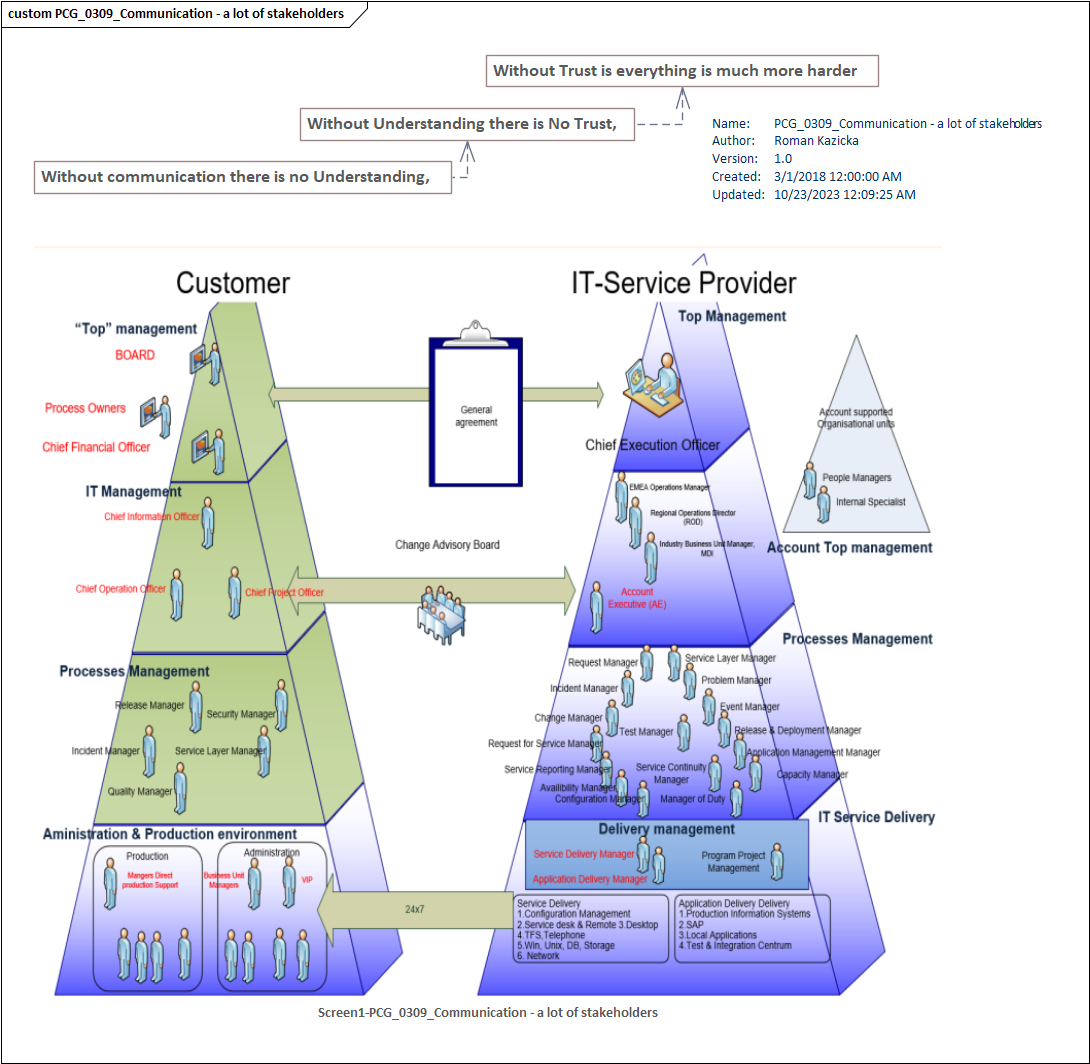
The diagram above shows the complexity of a typical IT service relationship. Customer on the left: Board, CFO, Process Owners, IT Management, Operations. IT-Service Provider on the right: CEO, Operations Managers, Account Executive, dozens of process roles.
Not everyone needs to create the taxonomy. But everyone needs to rely on it.
🧩 Frameworks covered in this article
This article is split into focused sections:
| Framework | What it addresses | Details |
|---|---|---|
| APV | Vocabulary of solution assets — what exists, from whose perspective, what they see | K000107 – APV |
| SFIA | Vocabulary of people and skills across IT roles | K000107 – SFIA |
| TBM | Vocabulary of IT costs connecting technology to business value | K000107 – TBM |
Before building any model or document in your SDLC:
- What asset are we describing?
- From whose perspective are we looking at it?
- What view does this stakeholder actually need to see?
📜 The logarithmic acceleration
Computer science is 80 years old. From Aristotle to Linnaeus it took roughly 2,000 years. But look at the pace of change:
| Transition | Duration | Context |
|---|---|---|
| 1st → 2nd industrial revolution | ~100 years | Steam → electricity & mass production |
| 2nd → 3rd | ~80 years | Electricity → computers & automation |
| 3rd → 4th | ~30 years | Computers → Industry 4.0, IoT |
| 4th → massive AI adoption | 9 years | Industry 4.0 → generative AI |
It is shortening logarithmically. Today it might already be months.
The urgency is real: AI does not work on intuition. Feed it conceptual chaos and it reproduces that chaos — quickly and confidently. The quality of your taxonomy directly determines the quality of your AI outputs.
AI amplifies what it receives. If your SDLC vocabulary is inconsistent across roles and phases, AI will consistently amplify that inconsistency — at speed and at scale.
✅ Summary
Taxonomy and ontology in SDLC are not academic concepts. They are the prerequisite for any organisation that wants to:
- Communicate effectively across roles and phases
- Measure what matters
- Build AI systems that produce reliable outputs
APV provides the framework for solution asset vocabulary. SFIA provides the framework for people and skills vocabulary. TBM provides the framework for cost and value vocabulary.
None of them requires starting from scratch. All of them require organisational commitment to shared language.
This connects directly to the CAA communication chain from K000103: Without Communication → no Understanding Without Understanding → no Trust Without Trust → no Collaboration Without Collaboration → no Synergy Without Synergy → no Success
Taxonomy is the infrastructure of Communication.
Bridge to next topics
A taxonomy tells you what the words mean. KERNARO shows you how AI can navigate that vocabulary in practice — see K000104.
Without a shared vocabulary, you cannot measure lead time. QRM shows you how to use that measurement to drive delivery speed — see K000108 – Quick Response Manufacturing.
Sources
- https://www.britannica.com/biography/Carolus-Linnaeus
- https://www.visionlearning.com/en/library/Biology/2/Taxonomy-I/70/
- https://sfia-online.org
- https://www.tbmcouncil.org
- https://quality-one.com/8d/
- https://rajansuri.com
- https://www.yarken.com/home